
If you're a school leader, your inbox is probably overflowing with pitches for the "next big thing" in education. Every program and platform claims to be the best solution for boosting student outcomes. But with your time and budget pulled in many directions, how can you tell what's a smart investment and what's just noise? It feels like you need a reliable system to cut through the clutter.
Well, that system actually exists. It's called the Every Student Succeeds Act (ESSA), and it offers a clear, practical way to make evidence-based decisions. We're talking about the ESSA framework.
We'll walk through its evidence tiers in plain English and show you how to use them to pick interventions that really do support academics and student wellbeing. Let's start.
What is the ESSA framework?
You've likely heard of ESSA, but a quick refresher can't hurt. Put into place in 2015, it replaced the No Child Left Behind Act as the main federal education law for K-12 public schools. The big idea was to hand the reins back to states and local districts, so that leaders like you can make choices that truly fit your community.
A huge part of that is how schools select and pay for support programs, or what ESSA calls "interventions." An intervention is really just any strategy or program you put in place to help students. It could be a new reading curriculum, a peer mentoring initiative, or a digital tool for wellbeing.
The ESSA framework is the system ESSA set up to help schools figure out the quality of the research behind any of these interventions. Think of it as a rating system for evidence. The whole point is to make sure federal money goes toward programs with solid proof that they get results.
ESSA's goal goes beyond grades or test scores. As Mental Health America notes, the law is designed to support the whole child. It acknowledges that things like a student's health and mental wellness correlate to their learning ability. If kids are dealing with anxiety or don't feel safe, it's going to be tough for them to learn. The framework helps you find solutions that take into account every part of a student's life.
The four tiers of the ESSA framework explained
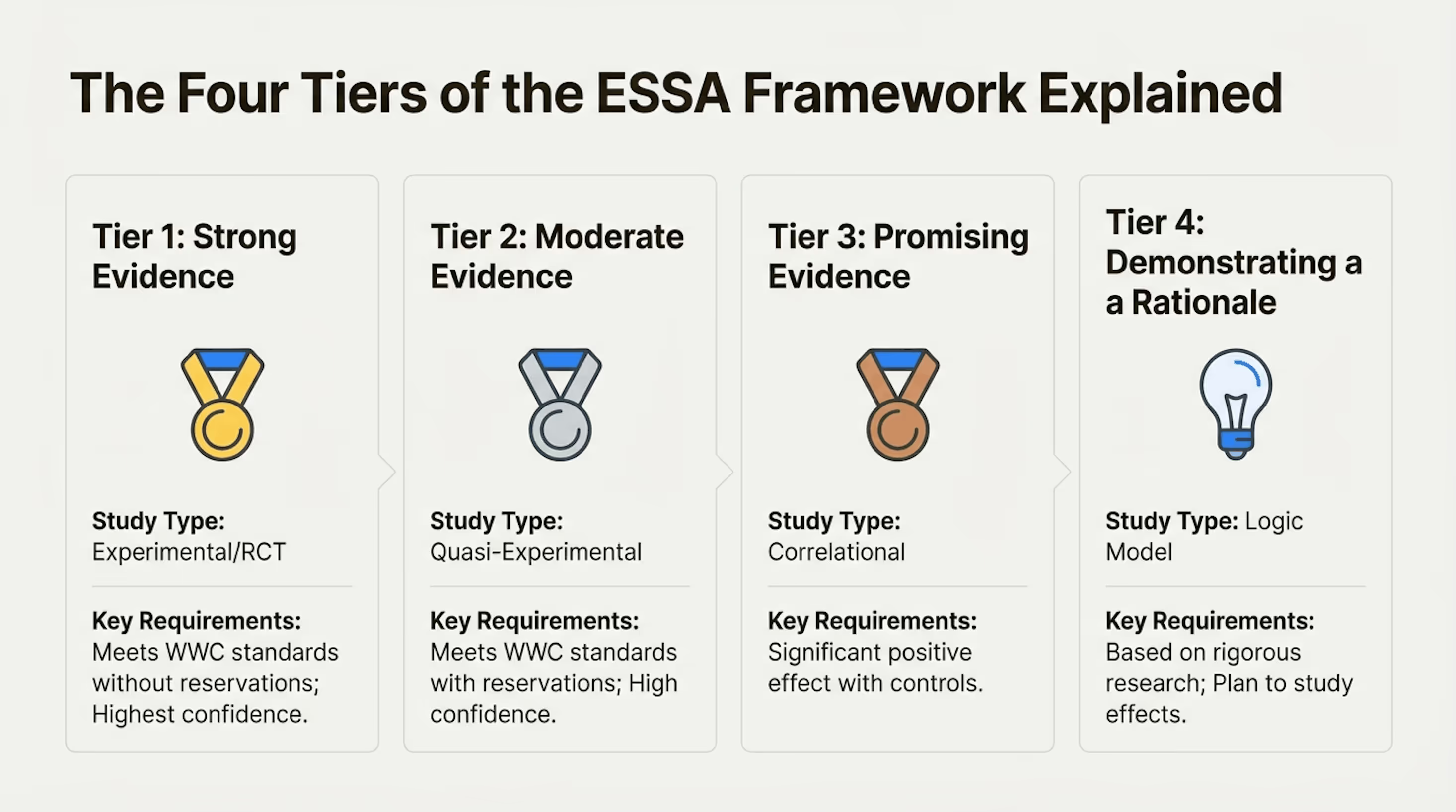
The ESSA framework organizes evidence into four levels, or tiers. They range from the most rigorous (Tier 1) to the most innovative (Tier 4). You can think of it as a confidence meter: the higher the tier, the more certain you can be that a program will do what it says it will.
Let's look at what each tier actually means for you.
Tier 1: Strong evidence
This is the gold standard. Tier 1 evidence comes from at least one large, well-designed experimental study. The key word here is "experimental," which almost always means a randomized controlled trial (RCT). In an RCT, researchers randomly assign students or schools to either get the intervention or be in a control group that doesn't. It's the best way to prove that the program caused the positive results, rather than just being associated with them.
To reach this top tier, a study has to meet WWC Standards Without Reservations. The WWC, or What Works Clearinghouse, is the part of the Department of Education that reviews all this research. The study also needs to show a statistically significant positive effect and involve a large group of at least 350 students across different campuses.
Tier 2: Moderate evidence
Tier 2 is still very solid evidence, but it's a little more flexible. This tier is based on quasi-experimental studies. The big difference is that these studies don't use random assignment. Instead, they create a comparison group that is statistically matched to the group getting the intervention. They'll match them on things like demographics and past academic performance.
Just like Tier 1, the study has to show a significant positive effect and meet the same large-scale sample requirements. The research simply needs to meet WWC Standards With Reservations, which just means it recognizes the limits of not having a fully randomized control group.
Tier 3: Promising evidence
This is where you'll find interventions that show a lot of potential but haven't been put through the wringer with a control group just yet. Tier 3 evidence is based on correlational studies. These studies examine the relationship between using a program and seeing a positive outcome.
The trick here is that the study has to use statistical controls to account for any pre-existing differences between students. This helps rule out other factors that might explain the good results. While it can't prove cause and effect, a well-done correlational study can give you strong early signs that a program is effective. The sample size rules are also a bit looser than for the top two tiers.
Tier 4: Demonstrating a rationale
Tier 4 is all about making room for innovation. Sometimes you need a totally new approach for a problem that just won't go away, and new ideas don't come with years of research attached. This tier is for programs that are built on good theory and have a clear plan to be evaluated.
To qualify for Tier 4, an intervention needs a solid logic model that explains how and why it should work, based on existing, high-quality research. It also needs to have a formal plan in place to study its effect over time. This lets schools try out promising new ideas and add to the evidence base, as long as they're committed to measuring what happens.
Here's a helpful table to help you keep it all straight:
| Tier | Study Design | Key Requirements | What It Means |
|---|---|---|---|
| Tier 1: Strong | Experimental (RCT) | Meets WWC standards without reservations; statistically significant positive effect; large sample (>350) across many sites. | Highest confidence that the intervention causes the desired outcome. |
| Tier 2: Moderate | Quasi-experimental | Meets WWC standards with reservations; statistically significant positive effect; large sample (>350) across many sites. | High confidence based on comparison groups matched on key variables. |
| Tier 3: Promising | Correlational | Meets WWC standards with reservations; statistically significant positive effect; smaller sample allowed; must control for differences. | Good early evidence; correlation suggests promise, but doesn't prove causation. |
| Tier 4: Demonstrates a Rationale | Logic model | Based on proven theory; clear explanation of how intervention should work; plan in place to evaluate effectiveness. | Room for new ideas grounded in research; intervention will be rigorously studied. |
Why the ESSA framework matters for student wellbeing
It's easy to pigeonhole the ESSA framework as something for reading or math programs. But it's just as important for choosing supports that focus on the whole child, including their mental and social-emotional health.
Schools are dealing with a massive challenge right now. Student mental health needs are higher than ever, but resources like school counselors and psychologists are often stretched impossibly thin. The numbers just don't add up; most schools can only give direct, intensive help to a small fraction of their students. This leaves a huge gap and a real need for effective, scalable Tier 1 support systems that every student can access, not just the 10-15% who are in crisis.
This is where using the ESSA framework is so critical. It helps you look beyond marketing materials and put your money into wellbeing solutions that are proven to work. It helps you choose programs that can show a real, measurable impact on things like student attendance, school climate, and overall wellness.
The tricky part, of course, is finding programs that can provide this universal support without breaking the bank, all while meeting evidence standards. Hiring more staff often isn't an option. This is where modern, evidence-backed digital tools can make a huge difference, offering a way to support every single student in a personalized and affordable way.
How to use the ESSA framework to select interventions
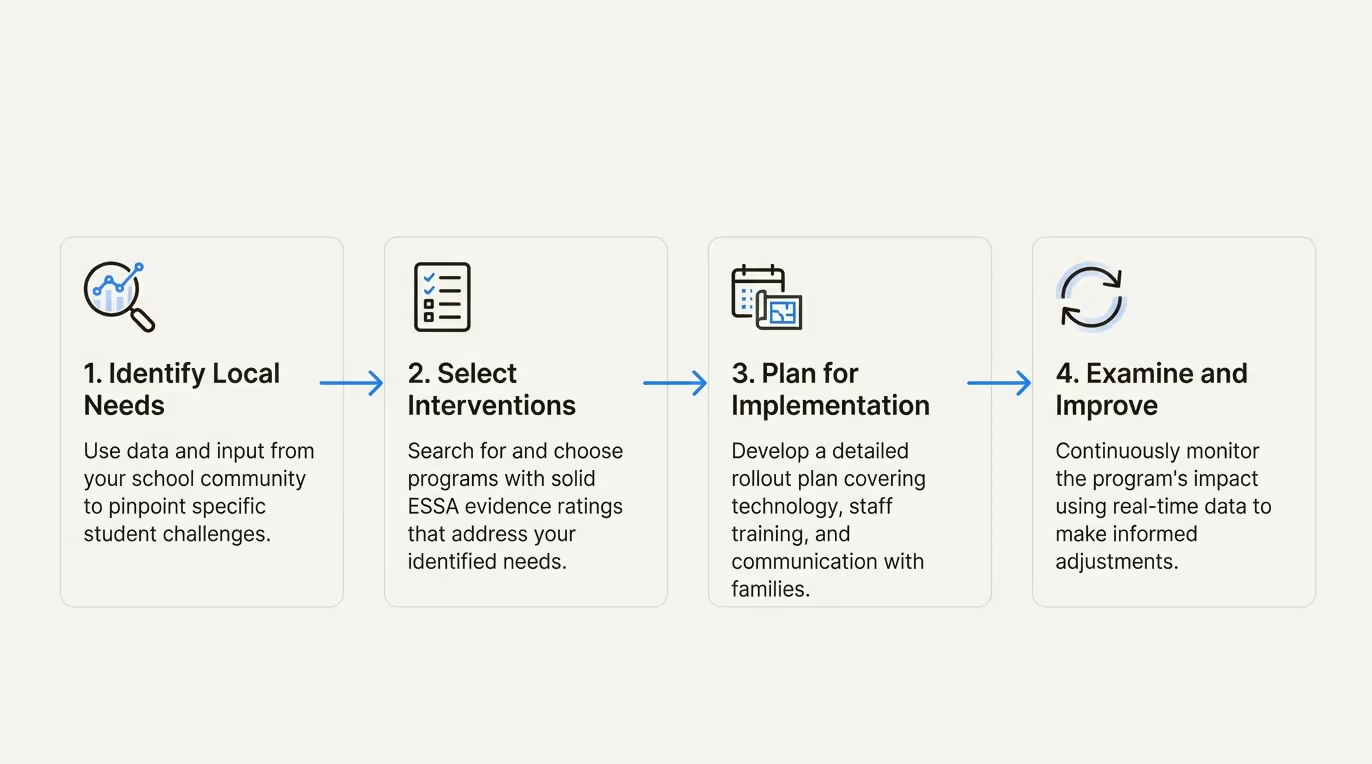
So, how do you actually use all this information? Applying the framework isn't some complex, bureaucratic headache. It's a pretty straightforward cycle of improvement you're probably already using. Here's a step-by-step guide to get you going.
Step 1: Identify local needs
Before you even think about looking at programs, you need to know what problem you're trying to fix. Start by doing a needs assessment to get a clear picture of what your students are up against. Are you seeing a rise in chronic absenteeism? Are kids reporting a lot of test anxiety? Are friendship squabbles turning into bigger disciplinary problems?
Don't just rely on hunches. Use your data. Look at student surveys, attendance logs, visits to the nurse's office, and discipline reports. Even better, talk to your teachers, counselors, and the students themselves. The goal is to figure out exactly where your students need the most help so you can find an intervention that hits the mark.
"The alongside app helps students with their wellbeing by having somebody to talk to, because sometimes students, they may not necessarily feel comfortable directly talking to an adult, but this app will definitely help a lot of students to have that space to vent. And you can ask the app just about any question and it has an answer for almost anything. And if necessary, it can contact the adults or the counselors at your school to make sure they know what's going on."
Step 2: Select interventions
Once you know what you're looking for, you can start searching for interventions that fit your needs and have a solid ESSA evidence rating. You don't have to do this from scratch. Resources like the federal government's What Works Clearinghouse (WWC) are built to help you find and review programs.
For schools that want to provide scalable, Tier 1 mental wellbeing support, a solution like Alongside is an example of what to look for. Its effectiveness has been confirmed by a third-party evaluator to meet ESSA Levels 2, 3, and 4, and a Level 1 RCT study is already in progress.
This evidence translates into measurable results that can address needs identified in the first step. For example, studies found that students using Alongside had 20% fewer absences on average. And for students who started out with high anxiety, using the platform led to a clinically significant 25% reduction in anxiety symptoms. This is the kind of concrete, evidence-based impact the ESSA framework is designed to help you find.
Step 3: Plan for implementation
Picking the right program is only half the job. A fantastic intervention can fall flat if the rollout is confusing or poorly planned. That's why you need a detailed implementation plan.
Think through the nuts and bolts. What technology do you need, and do you have it? How will you train staff to use the program and help students with it? How will you let students and families know about this new tool and why it's there for them? A solid, thoughtful plan gives the intervention its best shot at succeeding.
Step 4: Examine and improve
The work isn't over after you launch the program. The last, and maybe most important, step is to keep an eye on things and see if the intervention is actually working for your students in your school. Are you seeing the changes you were hoping for in attendance, behavior, or student feedback?
This is another spot where modern tools can make your job a lot easier. A platform like Alongside, for instance, gives administrators access to school-level dashboards with real-time, anonymized data. You can see at a glance what topics students are talking about most, whether it's anxiety over grades, friendships, or stress at home. This lets you "examine and reflect" all the time, giving you the insights to make quick, data-informed decisions to better support your whole school community.
For a deeper dive into how evidence tiers are categorized and what they mean in practice, the Institute of Education Sciences offers a helpful overview:
This video from the Institute of Education Sciences explains the tiers of evidence defined by the Every Student Succeeds Act (ESSA).
Applying the ESSA framework to everyday work
Ultimately, the ESSA framework is more than a compliance exercise. It's a strong tool for making smart, well-planned decisions that can help every student you serve.
Being better informed about the four tiers of evidence, you can look beyond marketing claims and choose interventions backed by solid research. Adopting this system for student wellbeing, especially, is one of the most important things you can do to form a supportive district that keeps students feeling safe, seen, and ready to learn. Partnering with an evidence-based program gives admin stronger confidence toward that goal.
Take the next step with evidence-based support
If you're looking for a Tier 1 wellbeing solution that is evidence-informed, affordable, and built to support every student, see how Alongside can help you meet your school's goals. Schedule a 15-minute Zoom to learn more.


Want to Try Alongside?
Sign up for our free demo in just 30 seconds.